Blog · 24 October 2026 · 4 min read
Replacing a legacy Oracle Forms ERP without stopping the business
استبدال نظام أوراكل فورمز القديم دون إيقاف العمل
How a UAE property group moves off an Oracle Forms or desktop-era ERP: the parallel-run approach, what to migrate and what to leave behind, opening balances, and the mistakes that force a rollback.
AMBy Asad Malik — founder, Silaflux
Legacy ERPs do not get replaced because they stop working. They get replaced because nobody left can change them, the reports only run on one machine, and every new requirement turns into a manual spreadsheet that somebody maintains by hand.
The fear is always the same: the system holds years of contracts, cheques and journals, and the business cannot pause while you rebuild it. That fear is correct. It is also solvable, and the method is unglamorous.
Do not migrate. Run in parallel.
The version that fails is the big-bang cutover: build for a year, switch everything over a weekend, discover on Monday that the trial balance does not match. The version that works keeps the old system running and useful while the new one takes over one area at a time.
That means accepting, for a period, that two systems are alive. It costs more in the short term. It is the price of never having a Monday where the business cannot issue a receipt.
Start where the pain is, not where the data is
The instinct is to start with the general ledger, because that is where everything lands. It is usually the wrong first move, because the GL is the part most tangled with everything else.
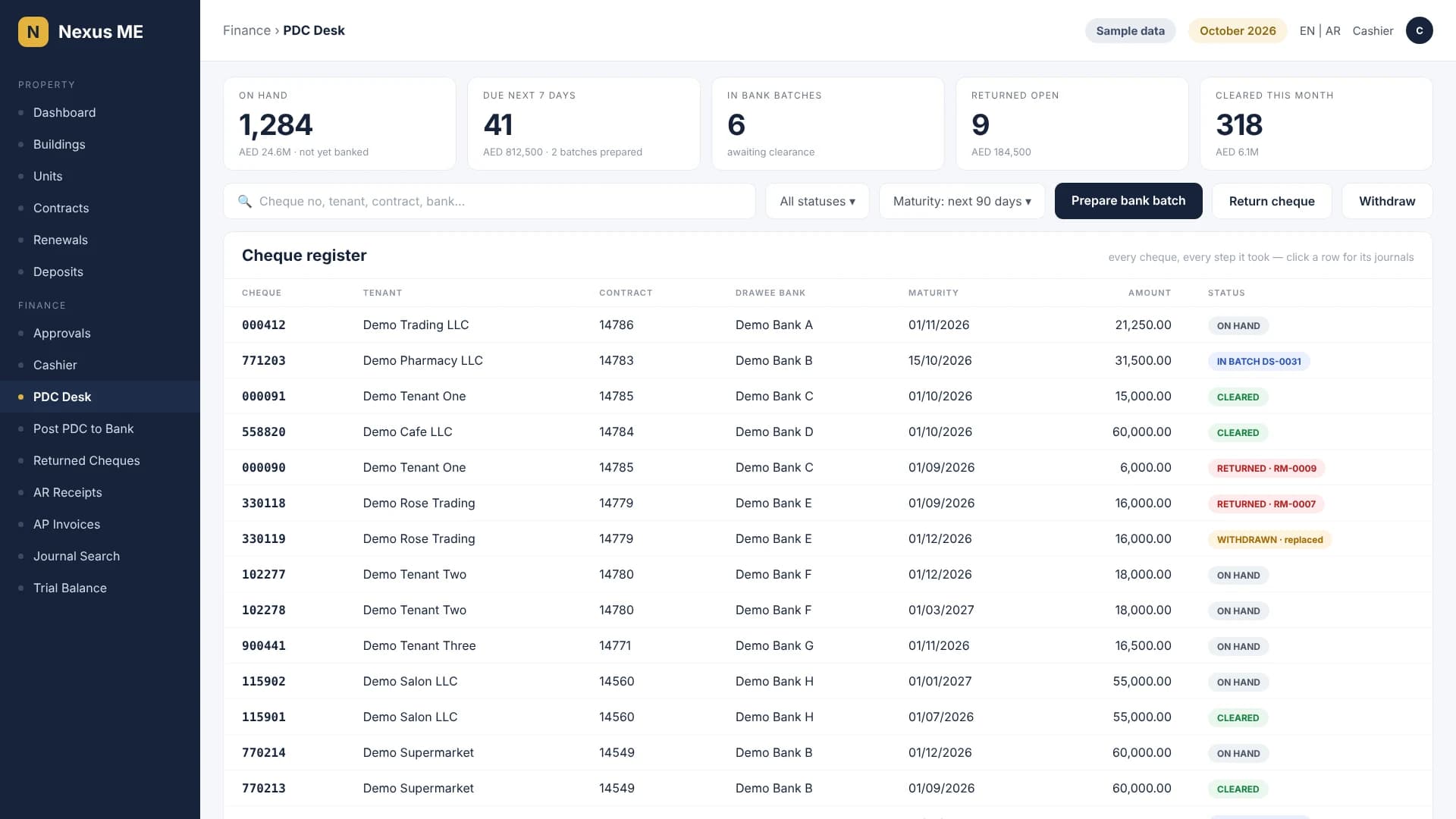
Start instead with a module that is self-contained and genuinely painful. For a property group that is often the post-dated cheque desk: high volume, clear rules, immediately visible benefit, and a manageable blast radius if something is wrong. People trust the new system because it made one real job easier, which buys you the goodwill for the harder modules.
Opening balances are the actual project
The code is rarely the hard part. The hard part is agreeing what the numbers are on day one.
- Trial balance. Take it at a clean period end. Debits equal credits, with no exceptions and no rounding plugs.
- Sub-ledgers. AR, AP, deposits and the cheque register each have to reconcile to their control account before you migrate anything. If they do not reconcile in the old system, they will not reconcile in the new one — you have just moved the problem.
- Open items only. You need open contracts, uncleared cheques, unapplied receipts and live deposits. You do not need every closed transaction since 2011.
- History stays where it is. Keep the old system readable for the statutory retention period and query it when you need an old document. Carrying a decade of closed journals into a new schema adds risk and no benefit.
Rebuild the rules, not the screens
A legacy system encodes years of hard-won business rules — the discount a leasing agent may approve without a signature, what happens when a cheque is returned, which postings a refund generates. Those rules are the asset. The green-screen forms are not.
Write the rules down explicitly before you build, because half of them exist only as habits. The useful question to the finance team is not "what does the system do?" but "what would you refuse to approve, and why?"
Guardrails are worth more than features
The single biggest improvement in most rebuilds is not a nicer interface. It is that the new system refuses things the old one allowed.
- Rent comes from the approved price list, not from whatever the agent types.
- A discount over the policy limit cannot be posted; it becomes an approval request.
- Prepared by one person, posted by another, on anything that moves money.
- Every posting writes a balanced journal — no exceptions, no back doors.
These are unpopular for about a month and then quietly save everyone's year.
What forces a rollback
- Cutting over before the sub-ledgers reconcile.
- Migrating history you did not need, and inheriting its errors.
- Rebuilding the old screens faithfully, including the workarounds people invented to get around them.
- Training nobody, then blaming the system when people keep using the old one.
- Turning off the legacy system before a full reporting cycle has run cleanly on the new one.
How long it takes
Longer than a demo suggests and shorter than a vendor quote implies. A single well-chosen module can be live in weeks. A full property and finance suite with a parallel run is a project measured in quarters, not sprints — and most of that time goes on reconciliation and training, not on writing code.
Nexus ME was built this way: a modern web ERP for a property group, with the legacy Oracle Forms system kept running until each area had proved itself. If you are staring at the same problem, book a free 20-min demo and we can go through where your own sub-ledgers stand.