Blog · 24 October 2026 · 4 min read
AML for Dubai real-estate brokers: goAML, the AED 55,000 cash rule, and what an inspection asks for
مكافحة غسل الأموال لوسطاء العقارات في دبي: goAML وقاعدة الـ٥٥٬٠٠٠ درهم
A plain-language guide for UAE real-estate brokers: why you are a DNFBP, what goAML registration involves, the AED 55,000 cash reporting threshold, and the evidence an inspection expects to see on file.
AMBy Asad Malik — founder, Silaflux
If you broker property sales in the UAE, anti-money-laundering rules apply to you directly. Not to your bank, not to the developer — to your brokerage. Most firms know this. What catches them out is not the law; it is that the deadlines live in one person's head and the evidence lives in four different folders.
Why a brokerage counts as a DNFBP
DNFBP stands for Designated Non-Financial Business or Profession. It is the category the law uses for businesses that are not banks but still sit close to large sums of money: real-estate brokers and agents, dealers in precious metals and stones, auditors, and company service providers.
For real estate, the trigger is concluding purchase and sale transactions on behalf of customers. If that is what your firm does, you are in scope, whatever your size.
What being in scope actually requires
- Register on goAML. This is the Financial Intelligence Unit's reporting platform. Registration is an obligation, not an option, and you cannot file a report without it.
- Appoint a compliance officer. A named person who owns this, with the authority to stop a deal.
- Do customer due diligence. Identify the buyer and the seller, understand who ultimately owns a corporate buyer, and check both against sanctions lists before the deal closes — not after.
- Keep records. Identification documents, the due-diligence you performed, and the reasoning behind your decisions.
- Report. Suspicious activity reports when something does not add up, and a Real Estate Activity Report in the specific cases below.
- Train your staff. Agents are the ones who meet the customer, so they are the ones who notice.
The AED 55,000 cash rule
A Real Estate Activity Report is required for freehold property purchases and sales where payment includes physical cash of AED 55,000 or more — whether that arrives as one payment or several, and whether it covers all or part of the price.
Two parts of that sentence cause most of the trouble. "Several transactions" means a buyer cannot stay under the line by paying in instalments; you have to look at the deal as a whole. And "part of the property" means a partial cash payment counts even when the rest arrives by transfer.
The same AED 55,000 figure applies to dealers in precious metals and stones under federal law, which is why gold and jewellery businesses face a near-identical obligation.
What an inspection actually looks at
Inspections are less about whether you have a policy document and more about whether the file for a specific deal is complete. In practice that means, for each transaction:
- Identification for the buyer and the seller, current and legible.
- For a corporate party, the ownership chain down to the real human beings behind it.
- Evidence that a sanctions check was run, with the date it was run.
- A written risk assessment for the customer, and the reason for the rating you gave.
- Source-of-funds evidence where the risk or the cash threshold calls for it.
- A record of any report filed, or a documented reason why none was needed.
Firms rarely fail because they refused to do this work. They fail because one deal from eighteen months ago is missing a passport copy, and nobody noticed until somebody asked.
The practical problem is tracking, not rules
A brokerage with forty live clients has forty renewal dates, forty sets of documents with different expiry dates, and a handful of cash deals that need review. Spreadsheets handle this until the person who maintains the spreadsheet goes on leave.
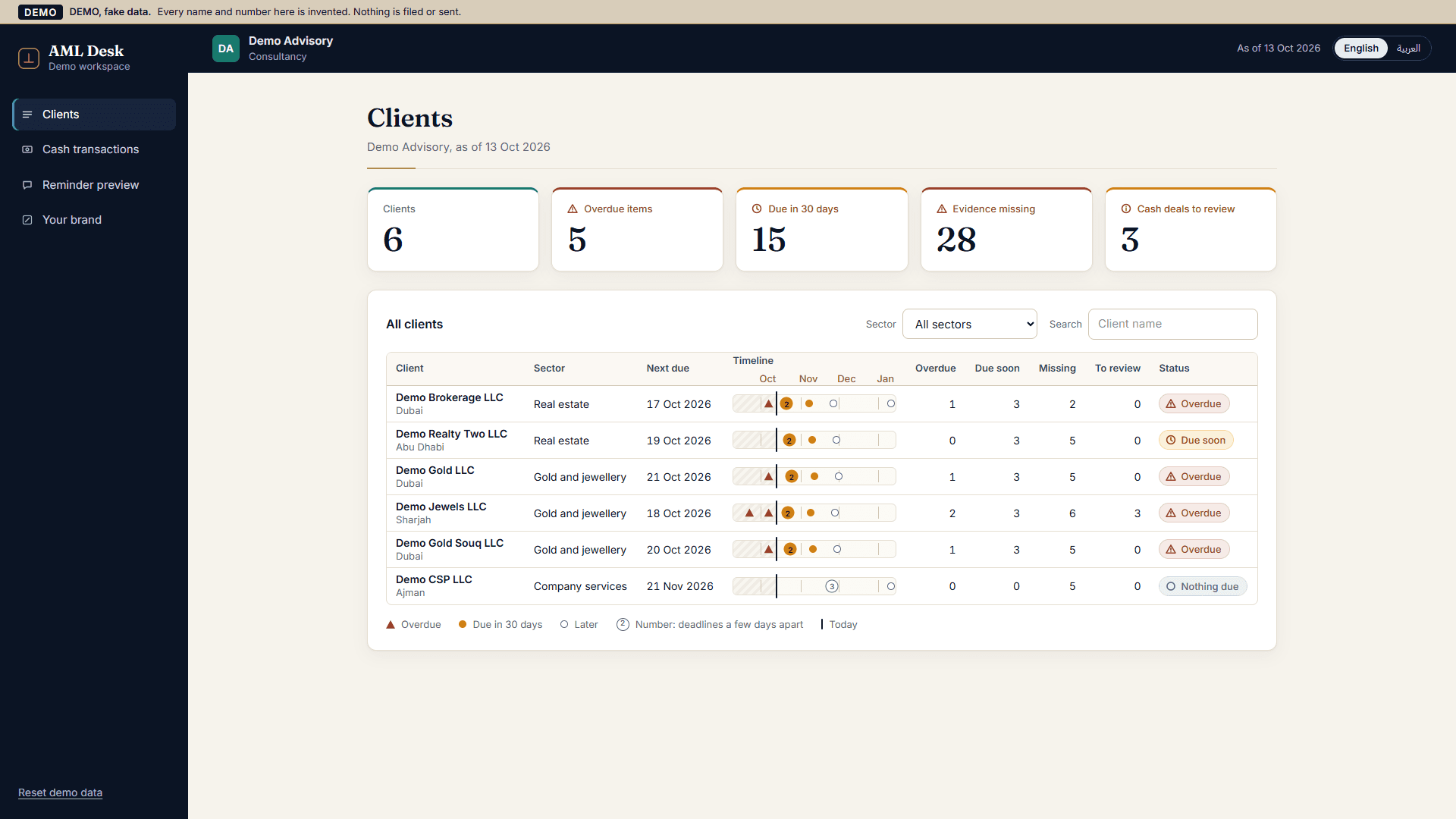
What actually helps is boring: one list of every client, what is due, what is missing, and when. Deadlines visible before they pass. Documents attached to the client, not filed by date. A log of cash deals that someone has to actively clear.
That is the shape of AML Desk — a tracker that shows which client file is missing evidence before an inspection asks, in English and Arabic. It is a tracker, not legal advice, and it does not replace your compliance adviser.
Three things worth doing this month
- Confirm your goAML registration is active and that someone still has the login.
- Pick three closed deals at random and check whether their files would survive an inspection today.
- Write down every client's next deadline in one place, even if that place is a spreadsheet for now.
If you want help turning that into something that maintains itself, book a free 20-min demo.