Blog · 24 October 2026 · 4 min read
WhatsApp Business API for Dubai brokers: the 24-hour rule, templates, and what it really costs
واتساب للأعمال لوسطاء دبي: قاعدة الـ٢٤ ساعة والقوالب والتكلفة الحقيقية
How the WhatsApp Business API actually works for a Dubai brokerage: the 24-hour customer service window, template approval, opt-in rules, per-conversation pricing, and the mistakes that get a number blocked.
AMBy Asad Malik — founder, Silaflux
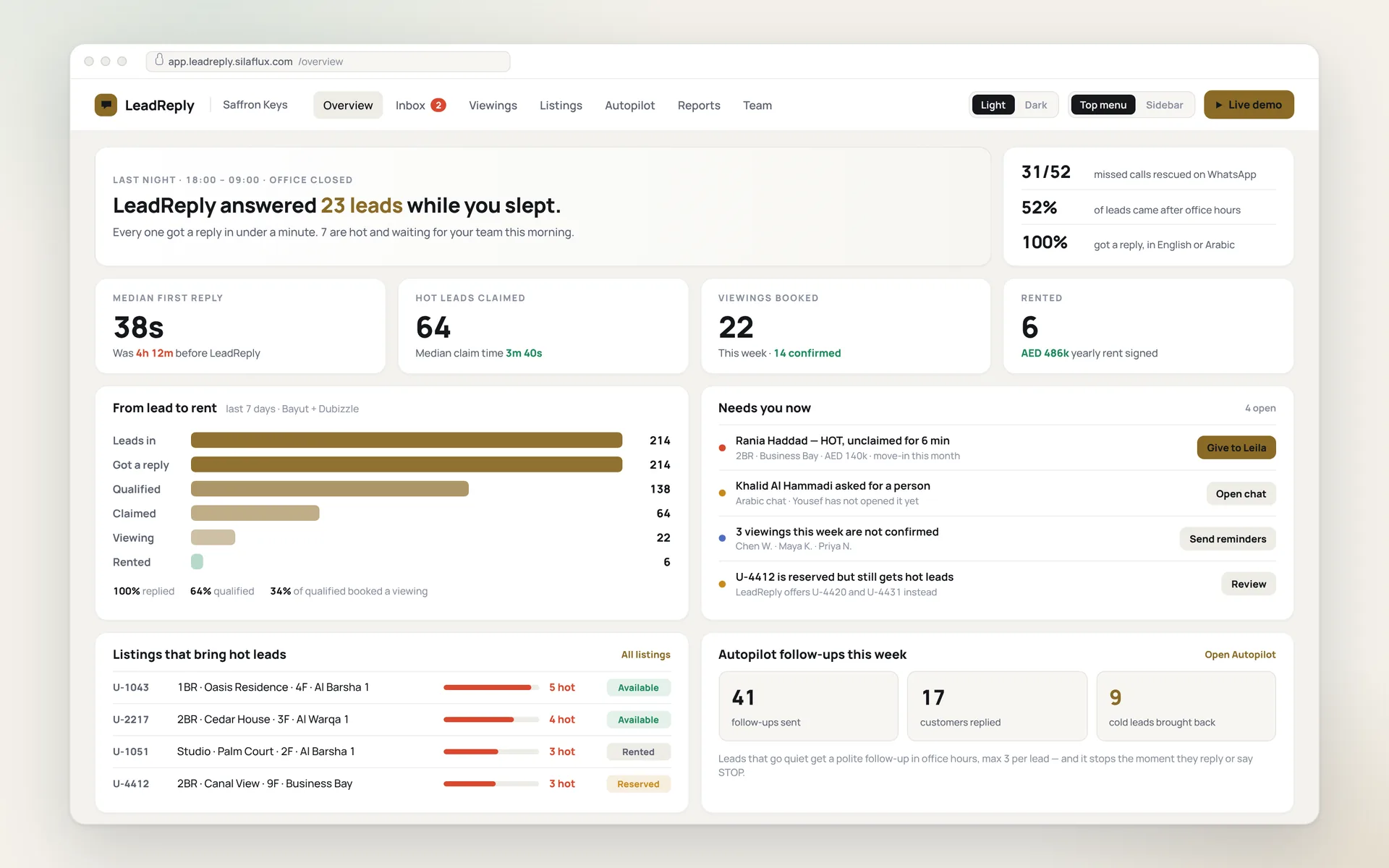
Most Dubai brokerages already run on WhatsApp. The agent's personal number is the CRM, the lead log and the viewing calendar all at once. It works until the agent is on a viewing, asleep, or leaves the company and takes the chat history with them.
The WhatsApp Business API is the version built for a company rather than a person. It is not an app you install — it is an interface your own software talks to, so replies can be automatic, logged, and shared across a team. Before you build anything on it, there are four rules worth understanding, because they decide what is and is not possible.
1. The 24-hour customer service window
When a customer messages you, a 24-hour window opens. Inside that window you can send free-form messages — anything you like, as many as the conversation needs. Once 24 hours pass with no new message from them, the window closes, and you can only reach them again with a pre-approved template.
This single rule shapes every automation worth building. A lead who writes at 9:41 pm can be answered, qualified and booked at 9:41 pm. The same lead, picked up at 11 am the next day, is a template message and a much colder conversation. Speed is not a nice-to-have on this channel; it is the difference between a free conversation and a restricted one.
2. Templates have to be approved first
Anything you send outside the window — a viewing reminder, a follow-up, a document request — has to be a template submitted for review in advance. Templates can carry variables (name, listing reference, time), but the shape of the message is fixed once approved.
Practically, that means writing your follow-up sequence before you build the automation, not after. A brokerage usually needs a handful: viewing confirmation, viewing reminder, a polite re-engagement for a lead who went quiet, and a document request. Write them in English and Arabic, because approval is per language.
3. Opt-in is not optional
You need the customer's permission to message them first. A lead who messaged you has given it for that conversation. A list of numbers exported from a portal has not. Buying a list and blasting it is the fastest route to a blocked number, and a blocked number takes your whole team's history with it.
The safe pattern is simple: reply to people who contacted you, and collect explicit opt-in on your own forms and listings for anything else.
4. You pay per conversation, not per message
Pricing is based on 24-hour conversation windows rather than individual messages, and the rate depends on the category — a conversation the customer started is cheaper than one you started for marketing. Rates change and vary by country, so check Meta's current pricing for the UAE before you budget. The practical point is that a chatty, helpful conversation costs the same as a one-line one, so there is no reason to be terse.
What this means for a brokerage
Put together, the rules point at one design: answer fast, inside the window, in the language the buyer wrote in, and get the useful facts out of the conversation while it is still free and warm.
- Answer in seconds, not hours. The window is the asset. Spending it is cheap; letting it close is expensive.
- Qualify in the first exchange. Budget, area, property type, move-in date and whether they are buying to live in or to invest. Five answers turn a name into a lead worth an agent's time.
- Hand over cleanly. The automation's job ends when a human takes the conversation. It should say it is the team's assistant, not pretend to be a person, and step aside the moment someone asks for one.
- Log everything. Every conversation belongs in your CRM or a sheet with the agent's name on it, so the history survives the agent leaving.
The mistakes that cost people their number
- Messaging purchased or scraped lists.
- Sending marketing templates to people who only ever asked a question.
- Ignoring opt-out requests. "STOP" has to actually stop it.
- Running the whole brokerage on one agent's personal number, so nothing is recoverable.
Build or buy
You need an approved WhatsApp Business account, a provider, your templates, and something that decides what to say. The first three are paperwork. The fourth is the actual product, and it is where a brokerage either gets a useful assistant or an irritating robot.
This is the job LeadReply does: it answers portal and WhatsApp enquiries in English or Arabic within the window, asks the five qualifying questions, scores the lead, books a viewing and hands it to the right agent with a short summary. If you would rather see it on your own listings than on a demo, book a free 20-min demo.